Nobody starts a business hoping to become a sales tax expert. You sell something, you ship it, you invoice it. Then one Tuesday a letter shows up from a state you have never set foot in, asking why you have not been collecting their tax for the past three years — and proposing a number with a comma in it that you did not budget for.
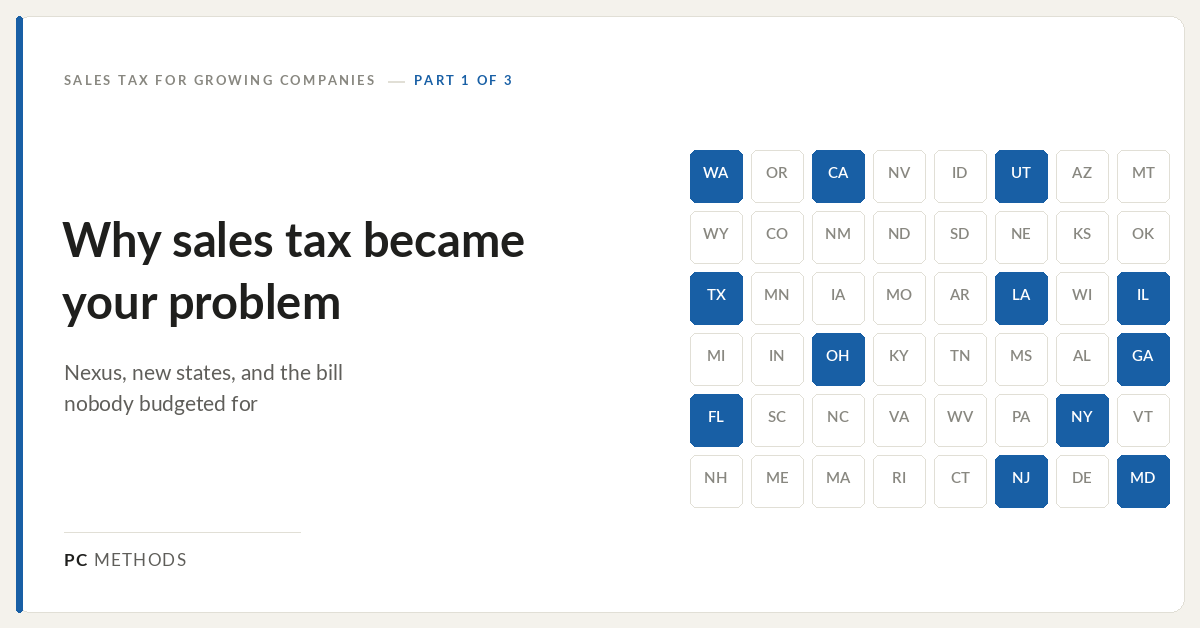
I have been working on accounting and ERP systems since 1979, and in that time I have watched sales tax go from a mostly local nuisance to one of the more reliable ways for a growing company to get blindsided. This is the first of three articles on the subject. This one covers why it is happening. Part 2 covers the returns you now have to file. Part 3 covers exemption certificates, which is where audits are actually won and lost.
States need money, and sales tax is the easiest lever to pull
This is the part that explains everything else. Sales tax is not a footnote in state budgets — it is a pillar.
According to the U.S. Census Bureau's Annual Survey of State Government Tax Collections, general sales taxes accounted for 30.9% of state tax collections in fiscal 2025, just behind personal income tax at 33.7%. Count every kind of sales and gross receipts tax and the share rises to 45.4% of state tax revenue nationally. In 20 of the 45 states that levy one, the general sales tax is the single largest revenue source. Florida gets 62.9% of its tax revenue from it.
When a legislature needs money, it has three choices: raise the income tax, raise the sales tax rate, or broaden what the sales tax applies to. The first is politically expensive. The second is visible on every receipt. The third is nearly invisible to voters — and that is the one states have been reaching for.
The Tax Foundation's midyear 2026 data shows how little movement there has been on headline rates: no statewide rate changed between January and July 2026, and Louisiana in January 2025 was the last state to raise one. Meanwhile the base has been quietly widening:
- Washington (ESSB 5814, effective October 1, 2025) extended retail sales tax to a range of IT services, advertising, custom software and the customization of prewritten software, and custom website development. Note the carve-outs — web hosting, domain registration, and print, radio, TV and out-of-home advertising were excluded — and that the law is under active constitutional and Internet Tax Freedom Act challenge, with further exclusions effective July 1, 2026.
- Maryland (HB 352, Ch. 604, Acts of 2025, effective July 1, 2025) imposed a new 3% tax on data and IT services — computing infrastructure, data processing, web hosting, systems design, and software publishing. Note that SaaS is taxed at 3% for enterprise use but at the full 6% rate for individual use, and that taxability turns on the service actually sold rather than on the seller's industry code.
- Louisiana (Acts 10 and 11 of the 2024 Third Extraordinary Session, effective January 1, 2025) pulled in digital products, "prewritten computer software access services" — which is how the statute describes SaaS — and information services.
- Utah (SB 162, effective July 1, 2026) expanded and codified tax on streaming, digital books, digital subscriptions, gaming services, and seller-hosted prewritten software. Utah already taxed prewritten software regardless of delivery method; the genuinely new ground is streaming-style access with no download.
Read that list again. Those are not obscure product categories. If you sell software, host anything, or bill for technical services, states have been rewriting the rules underneath you.
Wayfair removed the thing that used to protect you
For decades the rule was simple: no physical presence in a state, no obligation to collect its sales tax. On June 21, 2018, the Supreme Court decided South Dakota v. Wayfair and that protection ended. States may now require you to collect based on economic nexus — a dollar or transaction threshold — with no physical presence at all.
Every state with a sales tax has since adopted some version of it. The common threshold is $100,000 in sales into the state over twelve months, though the details vary and keep moving. Illinois is a good example of how the rules drift: under Public Act 104-0006, enacted June 16, 2025, Illinois eliminated its 200-transaction threshold effective January 1, 2026. Economic nexus there now turns solely on whether cumulative gross receipts from Illinois purchasers exceed $100,000 over the previous twelve months, measured quarterly. The same act extended Illinois's "Leveling the Playing Field" provisions to the Service Occupation and Service Use taxes, so an out-of-state servicerman transferring tangible personal property to an Illinois customer as part of a sale of service now collects state and local tax rather than just the 6.25% state rate. To be precise about what did not change: the Illinois Department of Revenue is explicit that the service component of a sale of service remains nontaxable — the taxable piece is the tangible personal property transferred along with it.
Nothing about your business changed on January 1. Your obligations did.
Physical presence did not go away — it just stopped being the only trigger
Economic nexus gets the attention, but old-fashioned physical nexus is still very much alive, and it is easier to trip than most owners think. Any of these can create it, depending on the state:
- An employee or contractor working from home in another state
- Inventory sitting in a third-party warehouse — this catches marketplace sellers constantly
- A salesperson making calls, or a technician doing installs and service visits
- A trade show booth, in some states, past a certain number of days
- Delivering in your own truck rather than by common carrier
Remote work quietly rewrote a lot of companies' nexus footprints between 2020 and today, and most of them never revisited it. One salesperson who moved to Tennessee can register you there whether you like it or not.
What a surprise assessment actually costs
Here is the part that stings, and it is the reason this is worth your attention before it becomes urgent.
Sales tax is a trust tax. You are supposed to collect it from your customer and hold it for the state. When you fail to collect it, the obligation does not disappear — it becomes yours. You now owe tax you never charged, and you are going to pay it out of margin you have already spent.
Say a distributor crosses a threshold in a state and does not notice for three years. On $2 million of sales into that state at an 8% combined rate, the exposure is roughly $160,000 in tax — before penalties and before interest, which in most states compounds. You can chase your customers for it. Most of them will not pay, and the ones who do will remember you as the vendor who sent a surprise invoice for tax on an order from 2023.
The lookback can also run much further than people expect. In most states the limitations clock is tied to a filed return, so a seller who never registered and never filed may have no protective clock running at all — Illinois, New York, and Texas all lift their normal three- or four-year bar when no return was filed. Some states do cap it: California limits assessments against non-filers to eight years, and Washington to seven years plus the current year. Which rule applies to you is a question for a state and local tax professional, not a rule of thumb. This is why most states offer voluntary disclosure agreements — come forward before they find you, and you typically get a limited lookback (often three or four years) with penalties waived. Those programs are only available before contact. Once the notice arrives, that door closes.
The three failure modes I actually see
In practice, companies land in trouble in three ways, and they are the three parts of this series:
- They do not know where they have nexus. Growth, remote employees, or a new marketplace channel put them over a line nobody was watching. That is this article.
- They register and then file badly. Missed returns, wrong frequency, forgotten zero returns, notices nobody opens. That is Part 2.
- They exempt sales they cannot document. Resale, nonprofit, and government sales get billed tax-free without a valid certificate on file, and the auditor assesses the tax anyway. That is Part 3.
The first one is the only one that is genuinely hard to see coming without help — which is the argument for monitoring rather than reacting.
What to do about it, in order
Map where you already have nexus. Twelve months of sales by ship-to state, plus an honest inventory of employees, contractors, inventory locations, and travel. Most ERP systems will give you the sales-by-state number in an afternoon; the harder half is the physical footprint, and that usually lives in someone's head rather than in a system.
Set up monitoring, not an annual scramble. Thresholds are rolling, so the useful question is not "did we cross a line last year" but "which states are we at 70% of right now." Modern tax engines watch this continuously; a spreadsheet updated quarterly is a distant second but far better than nothing.
Deal with historical exposure deliberately. If you find you crossed a threshold two years ago, registering today and quietly starting to collect does not fix the back years, and in some states it draws attention to them. A voluntary disclosure is usually the cheaper path. This is a conversation for your CPA or a state and local tax specialist, not something to improvise.
Then automate the ongoing work. Once you know the shape of the problem, you can size the fix. A company with nexus in three states and a simple product line can often handle this inside its ERP with maintained rate tables. A company with nexus in fifteen states, a mix of taxable and exempt customers, and products whose taxability varies by state has outgrown that, and a dedicated tax engine such as Avalara, Sovos, or TaxCloud starts to look cheap next to a single missed assessment.
That sizing question is the whole ballgame, and I will come back to it in Part 2 — because for a lot of remote sellers, a meaningful share of the filing work turns out to be paid for by the states themselves, and very few business owners know that.
Frequently asked questions
We only sell to other businesses. Does economic nexus still apply?
Yes. Thresholds are generally based on gross sales into the state, not taxable sales, in most states. B2B sales that are ultimately exempt for resale still count toward the threshold in many states, which means you can be required to register in a state where you will end up owing very little tax — and you still have to file. Documenting those exempt sales is Part 3.
Does selling through Amazon or another marketplace protect us?
Partly. Marketplace facilitator laws make the marketplace responsible for collecting on sales it facilitates. But your direct sales still count, and in several states your marketplace sales still count toward your own threshold even though the marketplace remits the tax. Inventory stored in a marketplace warehouse can also create physical nexus in that state.
We are a service business. Are we in the clear?
Less so every year. Washington, Maryland, Louisiana, and Utah have all recently extended sales tax to categories of digital and technical services. Illinois is a more nuanced case — effective January 1, 2026 it extended its collection rules for out-of-state servicemen to state and local tax, but the service component itself remains nontaxable there; what is taxed is tangible personal property transferred as part of the sale of service. Either way, "services aren't taxable" was a reasonable rule of thumb a decade ago and is not one now.
How far back can a state go if we never registered?
Potentially to the date nexus began. The lookback limits most people have in mind attach to filed returns, so a seller who never registered and never filed often has no clock running in its favor — Illinois, New York, and Texas all set the ordinary bar aside when no return was filed. A few states cap it anyway: California at eight years for non-filers, Washington at seven years plus the current year. That uncertainty is exactly what makes voluntary disclosure agreements worth exploring before a state makes contact.
Is a tax engine worth it for a company our size?
It depends entirely on the size of the problem, not the size of the company. Nexus in two or three states with straightforward products may not justify it. Nexus in a dozen states, or a product line whose taxability varies state to state, almost certainly does. Count your registered states, your monthly filings, and the hours your accounting staff spends on this, then compare.
This article is general information, not tax or legal advice. Sales tax rules vary by state and change frequently — confirm your own situation with your CPA or a state and local tax specialist.
Frankly, the hardest part of this is not the tax — it is finding out where you stand. If you are not sure which states you are registered in, which ones you should be, or whether your ERP is even capturing the data you would need to answer that, we can help you get a clear picture before a state does it for you.
We support Sage 300, Sage 50, Sage Pro, QuickBooks Enterprise, and custom FoxPro systems, and we have connected all of them to tax engines and reporting at one time or another.
📅 Book a call · 📧 peter.heinicke@pcmethods.com · 📞 630-208-8000
Next in this series: Part 2 — Sales Tax Returns: The Work Nobody Budgets For, including which states will pay for your filings.
Sources
- U.S. Census Bureau — Annual Survey of State Government Tax Collections
- Tax Foundation — State and Local Sales Tax Rates, Midyear 2026
- South Dakota v. Wayfair, Inc., 585 U.S. ___ (2018)
- Illinois Public Act 104-0006
- Illinois Department of Revenue — Informational Bulletin FY 2026-13 (Leveling the Playing Field / service transactions)
- Louisiana Department of Revenue — Sales Tax Reform FAQs (newly taxable services)
- Washington Department of Revenue — Services newly subject to retail sales tax
- Comptroller of Maryland — Technical Bulletin 56 (data and IT services)
- Utah Legislature — SB 162 (2026)
- Streamlined Sales Tax Governing Board — FAQs